
Enzymatic polymer synthesis emerges as a sustainable alternative to chemical methods, operating under mild and environmentally benign conditions. Integrating enantioselective synthesis with polymerisation enables the use of nonpolymerisable and prochiral molecules as monomers for biodegradable plastics. Here, the scale-up of a biocatalytic asymmetric reduction of β-ketoesters into enantiomerically pure β-hydroxy esters is presented. These β-hydroxy esters are readily polymerised to macromolecular polyesters by lipases under bulk conditions. By pairing immobilised ketoreductases with immobilised lipases of compatible enantioselectivity, either R- or S-stereoregular poly(3-hydroxybutanoate) was obtained, achieving 30–40% monomer conversion and molecular weights around 650 Da. The resulting stereoregular polymers have no detectable crystalline domains due to their low molecular weight. This approach expands sustainable routes to biodegradable materials and enables future development of continuous biocatalytic processes.
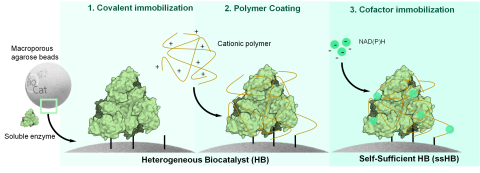
24/07/2026
Stepwise enzymatic synthesis of stereoregular poly(hydroxyalkanoates) starting from prochiral beta-Keto esters
Title: Stepwise enzymatic synthesis of stereoregular poly(hydroxyalkanoates) starting from prochiral beta-Keto esters
Journal: Bioresource Technology 2026, DOI: 10.1016/j.biortech.2026.135184