
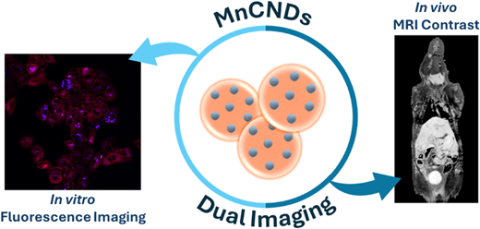
Carbon nanodots (CNDs) have emerged as highly promising nanomaterials for biomedical applications due to their intrinsic fluorescence, excellent biocompatibility, and facile surface functionalization. Doping CNDs with paramagnetic metals, such as manganese (Mn), enables the development of dual-modal imaging probes that integrate magnetic resonance imaging (MRI) and fluorescence imaging (FI). Mn is a particularly attractive alternative to Gd-based contrast agents, offering lower toxicity, favorable paramagnetic properties, and physiological relevance. Here, we report a rapid microwave-assisted hydrothermal synthesis of Mn-doped carbon nanodots (MnCNDs) as dual-mode contrast agents for MRI and FI. A size exclusion chromatography purification step yielded a uniform population of MnCNDs containing 5% (w/w) Mn(II), characterized by excitation-dependent fluorescence emission and an amorphous carbon structure with a metal-enriched core. Importantly, MnCNDs exhibit a stable longitudinal relaxivity over 7 days, comparable to that of clinically used MRI contrast agents. Confocal fluorescence imaging confirmed efficient cellular uptake in vitro, while T1-weighted MRI in mice demonstrated their biocompatibility and strong potential as effective MRI contrast agents for in vivo applications. These findings position MnCNDs as robust and versatile nanoprobes for next-generation, multimodal bioimaging.